Lower Academy
/ Upper Academy
Artist, Explorer, Scientist
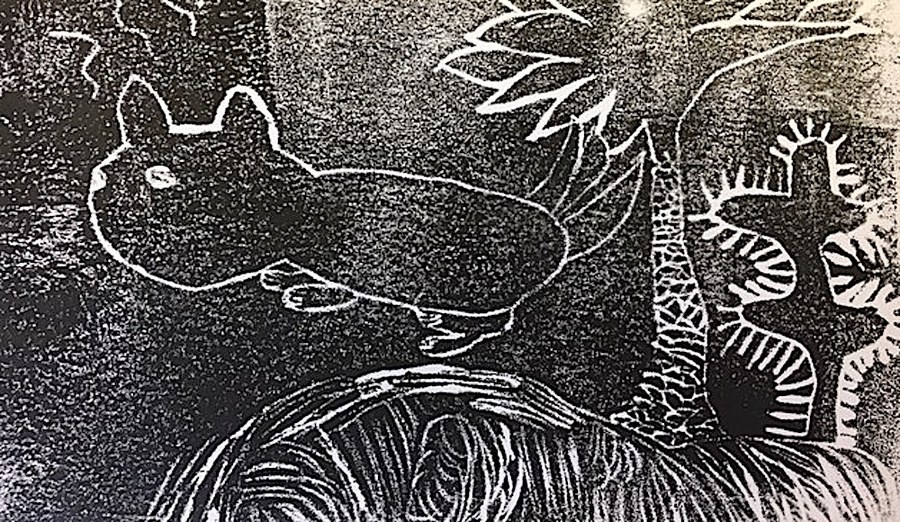
-From Ms. Leckies 1st Grade Class in Toronto, Ontario
In this project, student artists learn about how scientists use drawing in their field research. They focus their studies on the ornithologist John Audubon . He was notable for his extensive studies documenting all types of American birds and for his detailed illustrations that depicted the birds in their natural habitats. He eventually produced a book called ‘Birds of North America’ which contained 435 life-sized watercolours of North American birds, all reproduced from hand-engraved prints. Students begin the project by creating ‘field sketches’ through which they learn the basics of observation drawing. They then pick an animal figurine of their choice, draw it from observation, study the habitat of the animal, create an accurate background for their drawing, and then turn the drawings into a series of prints. Note: If an educator is unable to create prints with their students due to budget or space concerns, they can modify the project by using watercolor paper, skipping lesson 4 and instead have the
Copy paper, pencils, sharpener, erasers, botanical examples (e.g., flowers, leaves, etc.), copy paper & styrofoam printing plates of equal size, *animal figurines, tape, ball point pens. Group printmaking stations that include: Breyer (one clean and one for inking), **printing tray,*** printing ink, ****a selection of printing paper
N/A
photocopy 1
photocopy 2
© info: Doodles Academy presents both public domain artworks and works that are protected by copyright in their videos and lessons. The latter are used in accordance with fair use principle, as the images are only being used for educational purposes. If you are the copyright holder of the work of art used for Doodles-Academy.org and do not agree that the use of your image is a fair use, please contact us by email.ELA STANDARDS
SPEAKING & LISTENING
SL.3.1b Follow agreed-upon rules for discussions
SL.4.1b Follow agreed-upon rules for discussions and carry out assigned roles.
SL.5.1b Follow agreed-upon rules for discussions and carry out assigned roles.
SL.3.2 Determine the main ideas and supporting details of a text read aloud or information presented in diverse media and formats, including visually, quantitatively, and orally
Lessons 1- 4: discussing the inspiration image, Lessons 1-5: student artwork presentations
SL.3.1c Ask questions to check understanding of information presented, stay on topic, and link their comments to the remarks of others.
SL.4.1c Pose and respond to specific questions to clarify or follow up on information, and make comments that contribute to the discussion and link to the remarks of others.
SL.5.1c Pose and respond to specific questions by making comments that contribute to the discussion and elaborate on the remarks of others.
SL.3.4 Report on a topic or text, tell a story, or recount an experience with appropriate facts and relevant, descriptive details, speaking clearly at an understandable pace.
SL.4.4 Report on a topic or text, tell a story, or recount an experience in an organized manner, using appropriate facts and relevant, descriptive details to support main ideas or themes; speak clearly at an understandable pace.
SL.4.5 Add audio recordings and visual displays to presentations when appropriate to enhance the development of main ideas or themes.
SL.5.5 Include multimedia components (e.g., graphics, sound) and visual displays in presentations when appropriate to enhance the development of main ideas or themes.
SL.3.6 Speak in complete sentences when appropriate to task and situation in order to provide requested detail or clarification.
Lessons 1-5: student artwork presentations
WRITING
W.4.1d Provide a concluding statement or section related to the opinion presented.
W.5.1d Provide a concluding statement or section related to the opinion presented.
W.3.2d Provide a concluding statement or section.
Lessons 5: writing an artist statement
CREATING:
Anchor Standard 2: Organize and develop artistic ideas and work.
VA:Cr2.3.4a: Document, describe, and represent regional constructed environments. (lesson 3, creating the animals habitat)
Anchor Standard 3: Refine and complete artistic work.
VA:Cr3.1.3a: Elaborate visual information by adding details in an artwork to enhance emerging meaning. (Lesson 3, creating the animals habitat)
VA:Cr3.1.5a: Create artist statements using art vocabulary to describe personal choices in artmaking. (Lesson 5, writing an artist’s statement)
RESPONDING:
Anchor Standard 7: Perceive and analyze artistic work
VA:Re.7.1.5a: Compare one's own interpretation of a work of art with the interpretation of others. (Lesson 1-4, discussion of inspiration image)
VA:Re.7.2.3a: Determine messages communicated by an image.(Lesson 1-4, discussion of inspiration image)
VA:Re.7.2.4a: Analyze components in visual imagery that convey messages. (Lesson 1-4, discussion of inspiration image)
Anchor Standard 9: Apply criteria to evaluate artistic work.
VA:Re9.1.3a : VA:Re8.1.1a :Evaluate an artwork based on given criteria. (Lesson 1-5, during artist presentations)
VA:Re9.1.4a: Apply one set of criteria to evaluate more than one work of art. (Lesson 1-5, during artist presentations)
CONNECTING:
Anchor Standard 10: Synthesize and relate knowledge and personal experiences to make art.
Anchor Standard 11: Relate artistic ideas and works with societal, cultural, and historical context to deepen understanding (Lesson 1-5, creating a personally significant artwork after learning about the historical figure of John Audubon)
line, shape/form, space/perspective
proportion/scale
SOCIAL STUDIES CORE CONTENT
Core Content are common topics used all across America to address Social Studies and Science standards. This project supports the following core content in social studies:
National Events
- Westward Expansion (focus discussion on the the geography of his paintings)
- Regions/North America/West
Market Economy/Trade (focus discussion during lesson 4 & 5 on the development of his book, how he produced and sold it)
- Supply and demand
- Consumers and producers
- Entrepreneurship
SCIENCE CORE CONTENT
Core Content are common topics used all across America to address Social Studies and Science standards. This project supports the following core content in science:
Biology/Ecology
- Living things/organisms
- Plants
- Animals
- Habitats
Mathematics
Science
how scientists use field research and what scientific observation looks like easily support science lessons on plants/flowers/pollinations/etc by providing organic matter that aligns with the matter being studied in class during lesson 1.
Connects to lessons on animals/birds/habitats by providing appropriately aligned figurines in lesson 2
U.S. History
- extending the biography to include John Audubon’s business ventures which were affected by war, as well as his participation in the westward expansion
Geography
- John Audubon traveled all around the country and the paintings could be used to illustrate a variety of regions, most specifically the West.
 |
 |
 |